6 Best Cameras for Travel Blogging in 2026 (Beginner Friendly)
Let’s be honest. I’m no professional travel blogger. I’m just a person who loves taking out my phone while traveling, capturing photos and videos, and creating memories.
But my nightmare starts when I’m snapping a beautiful scene, I hit record, and boom! An error window pops up showing “Storage Full.”
Great. Now I’m left frantically deleting apps and old photos just to capture one moment that I may have already missed.
So, I wanted a camera that I could use easily—something that felt as simple as my phone (point, shoot, and go) but without the storage headaches and grainy low-light footage.
Yet, the deeper I dove, the more overwhelmed I got. There are just too many types of cameras for photos, videos, vlogging, and lenses. I felt like I needed a degree in film school just to choose one.
After a while, I realized the truth: the best camera for travel bloggers isn’t the most expensive one with the biggest lens.
It’s the one I will actually carry with me: something beginner-friendly and entry-level.
So here I am, sharing the best cameras for travel blogging that are lightweight, beginner-friendly, and will instantly upgrade your content from “home video” to “professional vlog.”
Disclosure: Some of the links below are affiliate links. I may receive a small commission if you purchase through my links, at no extra cost to you. I hope you find the information useful and will continue to support me in providing quality articles and travel guides.
Top Picks by Category
If you are in a rush, here are my top recommendations for every type of traveler:
- Best Overall Mirrorless: Sony A6500
- Best Value/Beginner: Canon PowerShot G7 X Mark II
- Best Compact/Action: Insta360 Go 3s
- Best for Stills & Video : Fujifilm X100VI
- Best For Underwater: GoPro HERO13
- Best for Vlogging: DJI Osmo Pocket 3
1. Sony A6500
Category: Best Overall Mirrorless

If you are looking for the best travel camera for professional photographers, the Sony A6500 is the one you should look into. It’s a compact powerhouse.
While this camera has been around for a little while, it remains a top choice for travel bloggers because of one specific feature: In-Body Image Stabilization (IBIS).
This means the sensor inside the camera physically moves to counteract your shaky hands. So, you don’t need to worry about shaky, amateur-looking videos with this one!
Key Features
- In-Body Image Stabilization (Steady shots without a tripod)
- Fast autofocus (Keeps you in focus while moving)
- Compact mirrorless body
I love this camera because it sits somewhere between a beginner and a pro. It’s small enough to fit in the jacket pocket (with a small lens) or your crossbody travel bag, but powerful enough to take incredible 4K video.
If you are planning to do a mix of street photography and vlogging, this is the best affordable camera for photography that gives you room to grow.
You can swap lenses later as you get better!
Pros:
- Stabilization is excellent for handheld video
- Weather-sealed body (great for dusty or damp travel)
- Huge selection of affordable lenses available
Cons:
- The menu system can be a bit confusing for total beginners
- Screen tilts but doesn’t flip out to the side
2. Canon PowerShot G7 X Mark II
Category: Best Value/Beginner
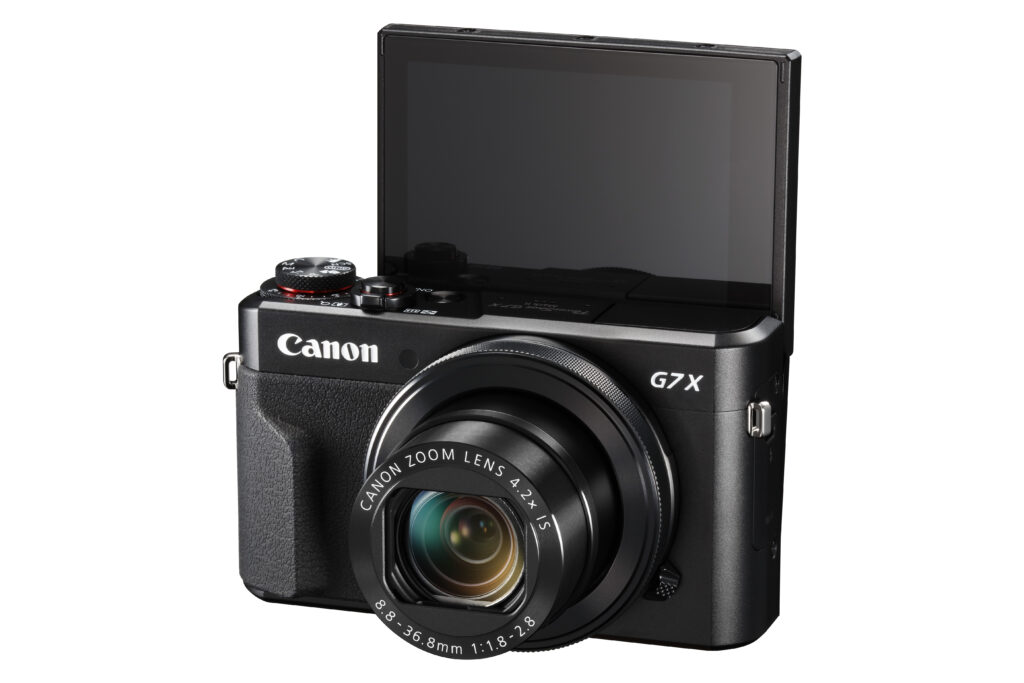
You have probably seen this camera in the hands of your favorite YouTubers or influencers. There is a reason for that.
When people ask me for good cameras for blogging that don’t require a degree to operate, this is always my first answer.
It is a “point-and-shoot,” meaning you can’t change the lens. But honestly? You don’t need to. The built-in lens is fantastic.
Key Features
- Flip-up screen (perfect for selfie angle)
- Great low-light performance (f/1.8 lens)
- Fantastic Canon “Color Science” (Skin tones look healthy)
This is the best compact camera for travel, affordable enough for most budgets. I find it incredibly approachable. You turn it on, flip the screen up, and hit record.
The colors look natural straight out of the camera, so you don’t need to spend hours editing on a computer. It’s perfect for vlogging in restaurants or dim hotel rooms where your phone struggles.
Pros:
- Fits easily in a pocket
- Beautiful skin tones without editing
- Very easy to use for beginners
Cons:
- Autofocus is good, but not as fast as the Sony
- No microphone jack (you have to use the built-in mic)
3. Fujifilm X100VI
Category: Best for Stills & Video (Hybrid)

On to the next one, the Fujifilm X100VI, a sleek camera on the higher end when it comes to price compared to the previous Sony A6500 and G7.
If style matters to you as much as performance, the Fujifilm X100VI is the queen of travel cameras. It looks like a vintage film camera, but inside, it is a modern beast.
It is one of the most stylish cameras for blogging because it is pretty and it matches any outfit as a fashion accessory for your outfits.
Plus, Fuji is famous for its modes that make your digital photos look like classic film stocks.
Just type “Fujifilm X100VI photos” into Google, and you’ll understand what I am talking about!
Key Features
- Incredible 40MP sensor (huge detail)
- Built-in Film Simulations (No editing needed)
- Fixed 23mm lens (forces you to be creative)
I’ll be honest: this camera is not cheap. But it does offer an all-in-one package. It’s perfect for the traveler who has extra money and would like to upgrade from an old camera model.
All in all, it shoots beautiful 4K video and even better photos. It definitely hits the spot when it comes to slowing down and enjoying the process of taking photos.
Pros:
- Stunning JPEG colors straight out of the camera
- The hybrid viewfinder is a pleasure to use
- In-body stabilization helps with video
Cons:
- A fixed lens means you can’t zoom (you have to walk closer)
- High demand often makes it hard to find in stock
4. Insta360 Go 3s
Category: Best Mini Compact Camera!
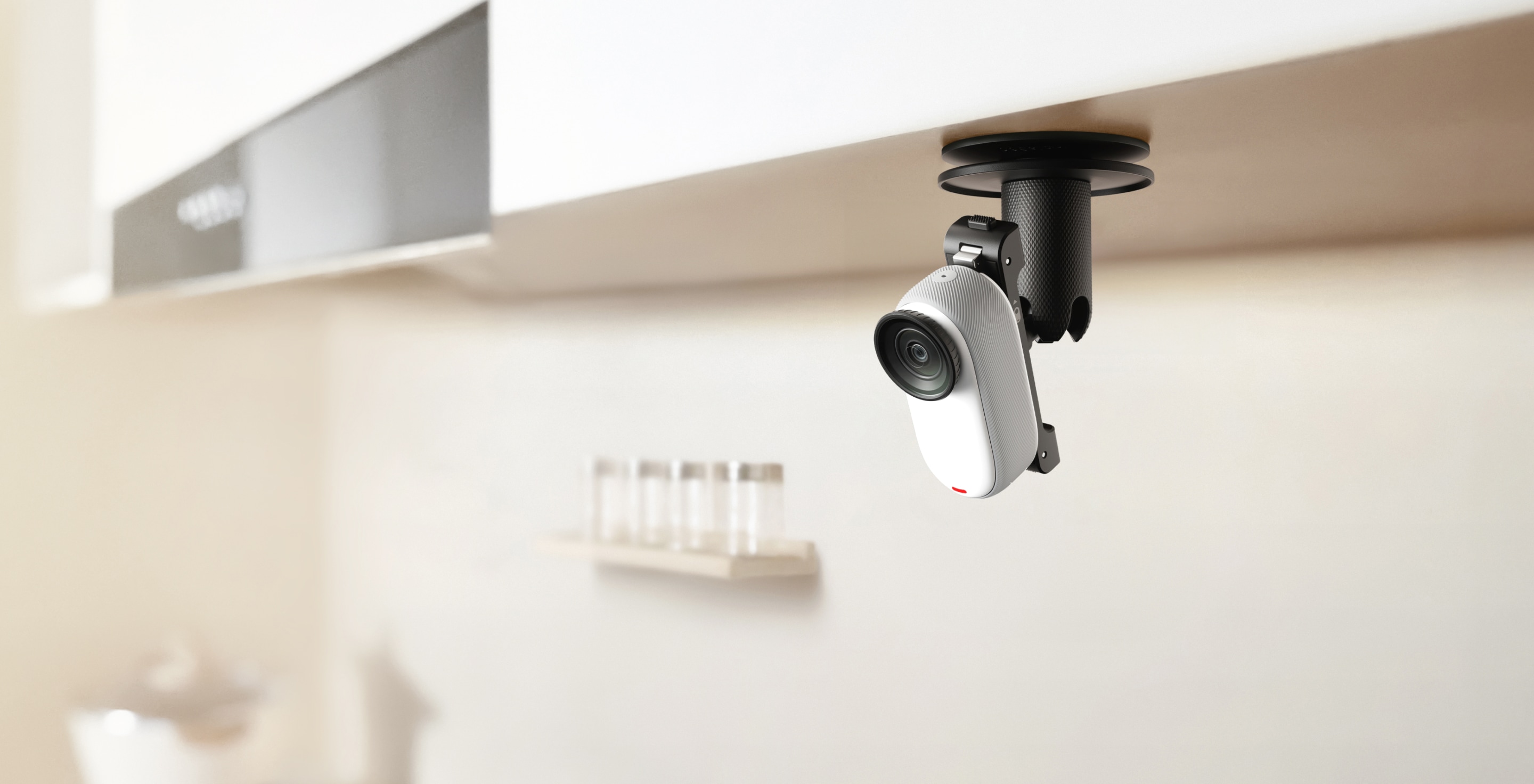
If you prefer to have something discreet and doesn’t look like a chunky ass camera, then this Insta360 Go 3s is for you.
This is the smallest camera on this list, and quite possibly the most convenient one ever made.
The Insta360 GO 3s is about the size of your thumb. It is designed to be worn, not held.
It comes with a magnetic necklace that you wear under your shirt, allowing you to snap the camera onto your chest and film hands-free. What a beauty!
If you want to capture authentic “POV” (Point of View) shots—like your hands holding a coffee cup or climbing a mountain trail, this is the best compact camera for travel affordable and practical.
Key Features
- Thumb-sized and magnetic! (mount it anywhere)
- Hands-free recording (wear it like a necklace)
- The Action Pod case has a flip screen
I use this when I want to be discreet. Sometimes walking around with a big camera makes people stare.
To be honest, when I am taking videos, I love using the DJI Osmo Pocket 3, but this Go 3s definitely wins when it comes to hands-free. Oh là là, la crème de la crème!
Nobody even notices I’m recording. It’s perfect for shy vloggers (like myself) or for capturing candid moments without a bulky setup.
Pros:
- Incredibly discreet and lightweight
- Unique “hands-free” angles are great for storytelling
- The case charges the camera (like AirPods)
Cons:
- No zoom and fixed wide angle (can look a bit “fisheye”)
- Battery life on the camera itself is too short in my opinion (38 minutes approx)
5. GoPro HERO13
Category: Best For Underwater (And Overall)
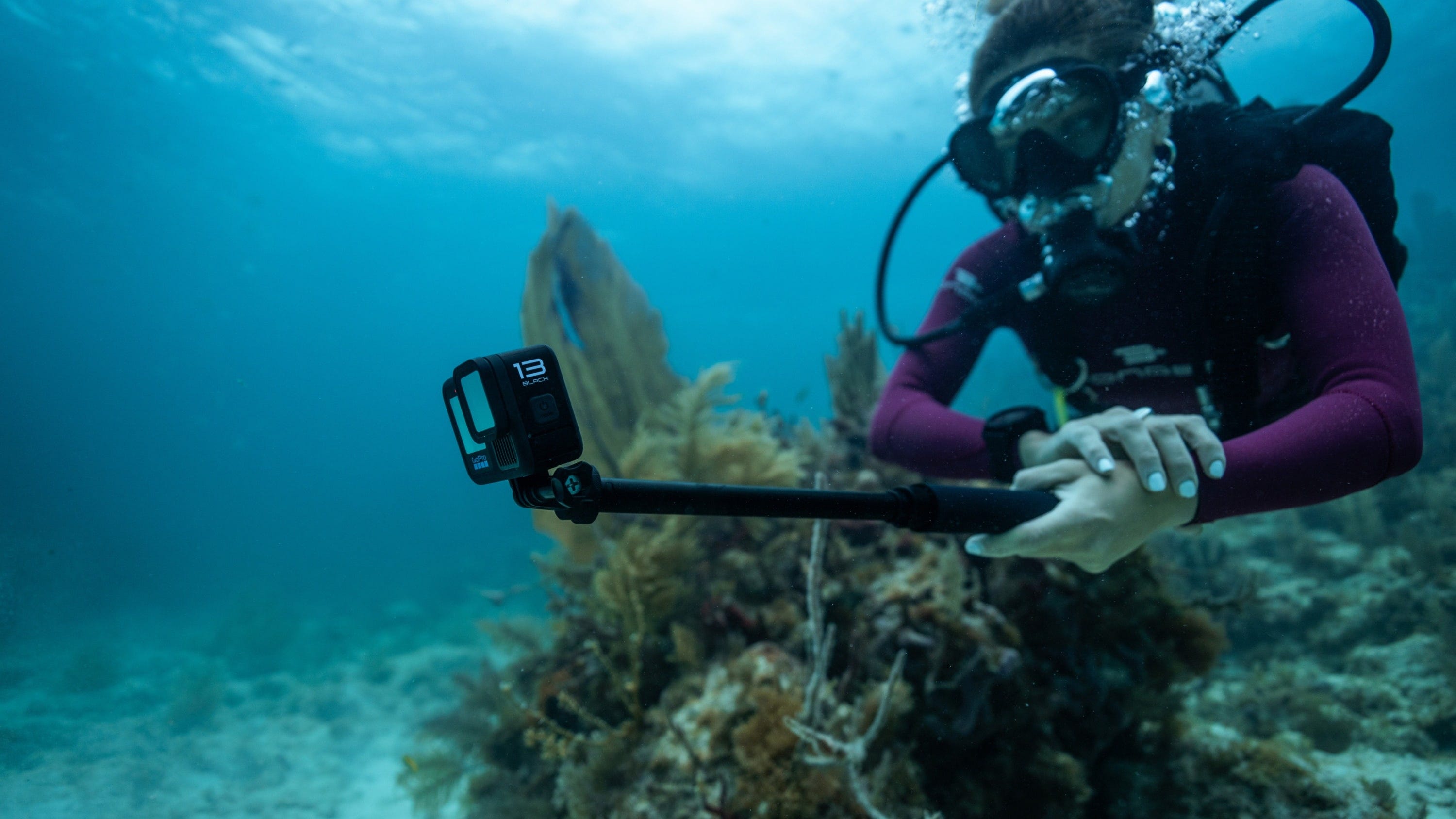
You probably know GoPro. They are the kings of action. If your travel style involves swimming, hiking in the rain, or just being a bit clumsy (like me), the GoPro HERO13 is your best friend.
It is practically indestructible. You can drop it, dunk it in the ocean, or cover it in mud, and it will keep recording.
Key Features
- Completely waterproof without a case (up to only 10 meters!)
- Horizon Lock (keeps the video level even if you tilt the camera)
I love using my GoPro for scuba diving shots since it can go underwater. Hit record, and it’ll do its job. If I am on the go, I strap it to my backpack while I’m hiking, and it captures everything.
Pros:
- You don’t have to baby it; it’s tough
- Waterproof straight out of the box
- Super wide-angle captures the whole landscape
Cons:
- Not great in low light (video gets grainy at night)
- Audio isn’t great if it’s windy
6. DJI Osmo Pocket 3
Category: Best for Vlogging

If you asked me to recommend just one camera to a solo traveler who wants to start vlogging today, this would be it.
The DJI Osmo Pocket 3 is weird. It doesn’t look like a camera; it looks like a wand. (Well, not as fancy as the Harry Potter wands!)
But that weird design is exactly why it’s brilliant. It has a built-in gimbal (a stabilizer) that physically moves to keep your footage buttery smooth, no matter how shaky your hands are.
Key Features
- Built-in 3-axis mechanical stabilization
- 1-inch sensor for great low-light performance
- Rotatable screen for instant vertical (TikTok) or horizontal (YouTube) shooting.
I took this little guy on a trip where I walked over 20,000 steps a day. The good things is, I didn’t have to stop, set up a tripod, or balance anything. A simple pull out of my pocket, turn it on (it boots up in 1 second), and you’re ready to talk.
The “ActiveTrack” feature is like having a cameraman. You draw a box around your face on the screen, and the camera physically turns to follow you as you move. It’s almost spooky how good it is.
The audio is also surprisingly good without an external mic, which means one less thing to buy.
Pros:
- Incredibly small; fits in a jeans pocket
- Stabilization is Hollywood-level smooth
- Excellent quality for night markets or dinners
Cons:
- Not water-resistant (you need a separate case)
- No zoom lens (you have to physically walk closer to your subject)
What Factors Should I Consider in a Camera for Blogging?
Choosing a camera is personal. Here are the three main things I look for when buying a new travel camera.
1. Compact & Lightweight
I cannot stress this enough. If a camera is too heavy, you will leave it in the hotel. I can bet you that you’ll end up using your phone instead.
When you are traveling, you are already carrying a backpack, water, and maybe a jacket. A heavy camera becomes a burden very quickly.
It is better to find something that fits in your pocket or a small bag.
2. Good Autofocus
When you are vlogging, you are often moving, talking, and showing things at the same time. Sharp footage and autofocus are what you want to look for.
You can’t fiddle with manual focus rings. You need a camera that locks onto your face instantly and stays there, even if you turn around or hold up a piece of food to show the lens.
3. 4K Video
You might think 1080p is enough, but 4K is the new standard for high-quality content. Even if you export your final video in HD, shooting in 4K allows you to crop into your footage (to zoom in) without losing quality.
It makes your content look sharper, more professional, and “future-proof” for years to come.
FAQ on the Best Camera for Travel Blogging
1. Do I really need a camera, or is my phone enough?
First, your phone is enough! But a dedicated camera gives you better battery life (so your phone doesn’t die when you need maps) and much better quality in low light.
2. What is the best camera for a solo traveler?
I highly recommend the Insta360 GO Ultra or the DJI Osmo Pocket 3.
They capture everything around you or track your face automatically, so you don’t need to worry about framing the shot. It’s like having a cameraman with you.
3. Which camera is best for travel vlogging?
The best camera for travel vlogging is the DJI Osmo Pocket 3. It is known for its ultra-smooth, compact footage. It’s lightweight and easy to use for the whole day.
It is designed to look sleek. The best part is, you can film either in horizontal or vertical mode with just a slight push of your thumb.
Final thoughts
These are all some of my top favorites as one of the best cameras for travel blogging that are beginner-friendly.
I totally understand that choosing a camera is a big decision, but don’t let the technical specs paralyze you.
After all, the camera is just a tool. The best part of your travel blog is you and your story.
I started with a simple camera, and it taught me so much about framing and storytelling. My advice? Pick the one that fits your budget and your travel style, and just start filming.
The best footage is the one you actually capture, not the one you wish you had a better camera for.
I hope this guide helps you find the perfect partner for documenting your travels. Now, get out there and start recording!
Pro-Tip: Don’t forget accessories like extra batteries, SD cards, a small tripod/gimbal, and a good strap to complete your travel setup.